
Endless compounds at a glance: MX87, ME22 and N39S compared
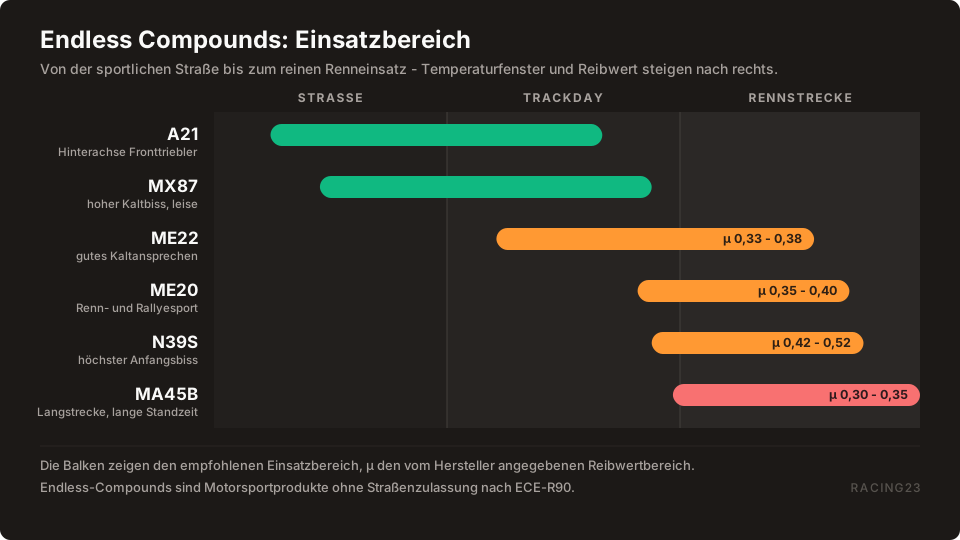
Endless offers its own compound for almost every use - from MX87 through ME22 to N39S. The designations reveal little at first glance. This overview sorts the most important Endless brake pads along the road, track day and race track axis, gives friction values and temperature windows, and puts the three most-asked-for compounds side by side.
MX87: the all-rounder for road and light track day
MX87 is the most versatile Endless compound for sporty road use and the further development of the MX72, which is only available while stocks last. It bites willingly even when cold, responds quickly and stays everyday-capable with low noise and dust levels - the first choice when a car is driven mostly on the road and only occasionally on track.
Its temperature window covers sporty road driving, mountain passes and light track days. For most drivers with mixed use, the compound search ends right here.
ME22: the upper temperature window for hard track days
ME22 starts a step higher. The compound shifts the usable temperature window upward and delivers noticeably more reserve against fade on the race track. Compared with the older ME20 it responds better when cold and develops less temperature; its coefficient of friction is around 0.33 to 0.38.
On the road ME22 is only partly suitable, because it needs more warm-up travel when cold. Anyone doing four to ten hard track days a year, or regular tourist drives on the Nordschleife, is right with ME22.
N39S and the pure race compounds
N39S is a pure race pad with a very high initial bite (coefficient of friction around 0.42 to 0.52), fast response and high temperature resistance. It works best under consistently high brake temperatures and belongs on the race track, not in everyday traffic.
Alongside it stand ME20 for racing and rallying and MA45B, the endurance compound for 6, 12 and 24 hour races with a much longer service life. For the rear axle a harder endurance compound is often combined, to keep the brake balance stable over long stints.
MX87, ME22 and N39S at a glance
- MX87: sporty road and light track day, bitey when cold, quiet and everyday-capable.
- ME22: hard track days and racing, high temperature window, only partly suitable on the road.
- N39S: race track and competition, highest initial bite from operating temperature.
- All three have one thing in common: they are motorsport products without ECE-R90 road approval.
The rest of the programme: from A21 to ceramic
- A21 - high-performance mix for road and track day, focused on the rear axle of front-wheel-drive cars.
- SSM+ - comfortable sporty road pad with particularly low noise and dust.
- ME20 - compound for racing and rallying with excellent pedal feel across the whole speed range.
- MA45B - endurance compound with a 2.5 to 3 times longer service life than the ME20.
- CCD-P, CCD-A and CCD-R - ceramic compounds for carbon-ceramic brake discs, from road to race track.
Frequently asked questions
- What do the Endless designations like MX, ME or N mean?
- The abbreviations roughly assign the pad to a family of uses: MX compounds (such as MX87) are the sporty, track-day-capable all-rounders, ME compounds (ME20, ME22) are pure race pads for dry conditions, N compounds like N39S stand for a very high initial bite, and on top of that come road and comfort ranges as well as special endurance and ceramic compounds. The number is not a direct friction value but a manufacturer code - so do not be guided by higher digits alone.
- What happens to MX72 and MX72 Plus?
- Both are being discontinued and replaced by the MX87; while stocks last they are still available. MX87 is the direct successor with a higher cold bite and faster response - anyone who used to run MX72 or MX72 Plus moves to the MX87.
- Does ME22 attack the brake discs more than MX87?
- Tends to, yes. Harder, more heat-resistant race compounds like ME22 - and even more so N39S - demand more of the disc and of themselves under hard use than the more civil MX87. In return they stay durable up to temperature. For predominantly road use that is one more reason to stick with the MX87.
- Can I combine MX87 at the front and ME22 at the rear?
- Mixing compounds is basically possible and is done to fine-tune the brake balance - but usually the other way around, with the grippier pad up front. MX87 front and ME22 rear would tend to shift the balance toward the rear and only makes sense in special cases. When in doubt, run the same compound per axle or give us a quick call.
Related topics
Next step
Choose a vehicle, then see matching brakes
Enter the HSN/TSN from your registration document (fields 2.1 and 2.2) or search by make and model.
All articles in the knowledge base